



Major cultural events are often treated like predefined media opportunities.
A major game happens. A large audience gathers. Brands try to reach that audience.
That approach oversimplifies what is actually happening.
During live cultural moments, consumers engage through overlapping motivations that continuously evolve before, during, and after the event.
A person following the World Cup may be a soccer fan, but they may also be planning a trip, looking for merchandise, following a national storyline, watching highlights on social media, researching a host city, or preparing for a family gathering.
Those signals matter because they reveal why someone is paying attention.
Traditional targeting often compresses that complexity into broad labels like “sports fans,” “soccer enthusiasts,” or “World Cup viewers.” While those labels may be easy to activate through traditional targeting segments, they rarely capture the full range of motivations shaping consumer behavior.
Consumer intent is more dynamic than that.
To illustrate this, we analyzed a live audience model built around the 2026 FIFA World Cup. What we found was not a single audience of soccer fans, but an evolving ecosystem of concepts made up of behaviors, locations, and motivations changing in real time.
What IntentKey AI Uncovered in a 2026 FIFA World Cup Audience Model
The 2026 FIFA World Cup IntentKey audience model showed what marketers should expect from a live global event:
- rapid audience growth
- shifting sentiment
- regional patterns
- a signal ecosystem extending beyond soccer
In the weeks leading into the tournament, the model’s potential audience size showed major increases as match week approached:
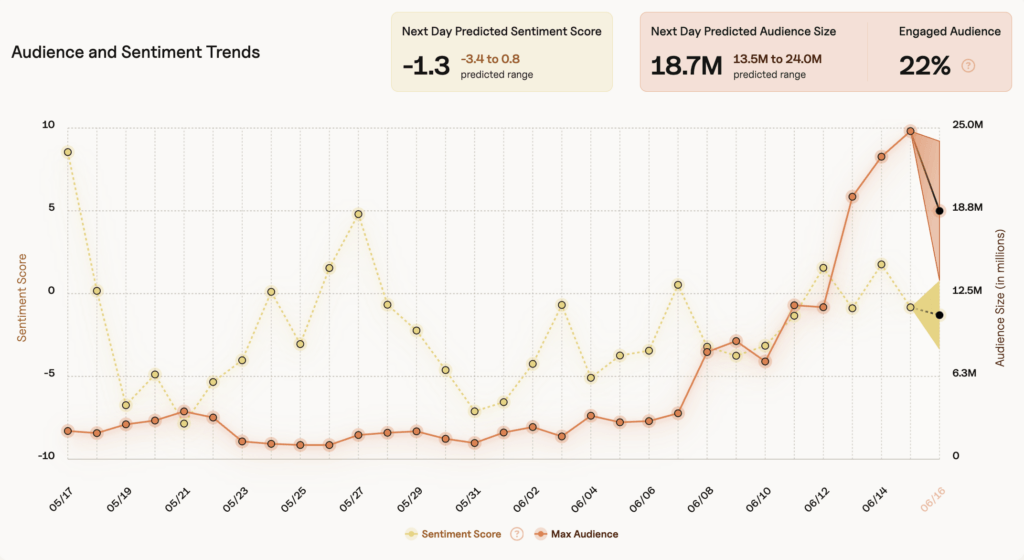
Image: Screenshot from FIFA World Cup IntentKey Audience Model shows spike in audience growth and sentiment trends leading up to the global event.
- Audience size rose sharply on June 8, growing from 3.5 million to 8.9 million as opening week approached.
- Audience size rose sharply again on June 11, increasing from 7.4 million to 11.6 million on the day of the opening matchup between Mexico and South Africa.
At the time of writing, the model continues evolving, with the potential audience reaching more than 24 million.
That growth is important, but the more interesting insight is what was driving it.
The audience was not simply getting larger. It was becoming more layered.
IntentKey AI surfaced concepts in the model tied directly to the tournament like:
- FIFA
- FIFA World Cup
- Mexico National Football Team
- FIFA Fan Festival
- Major League Soccer
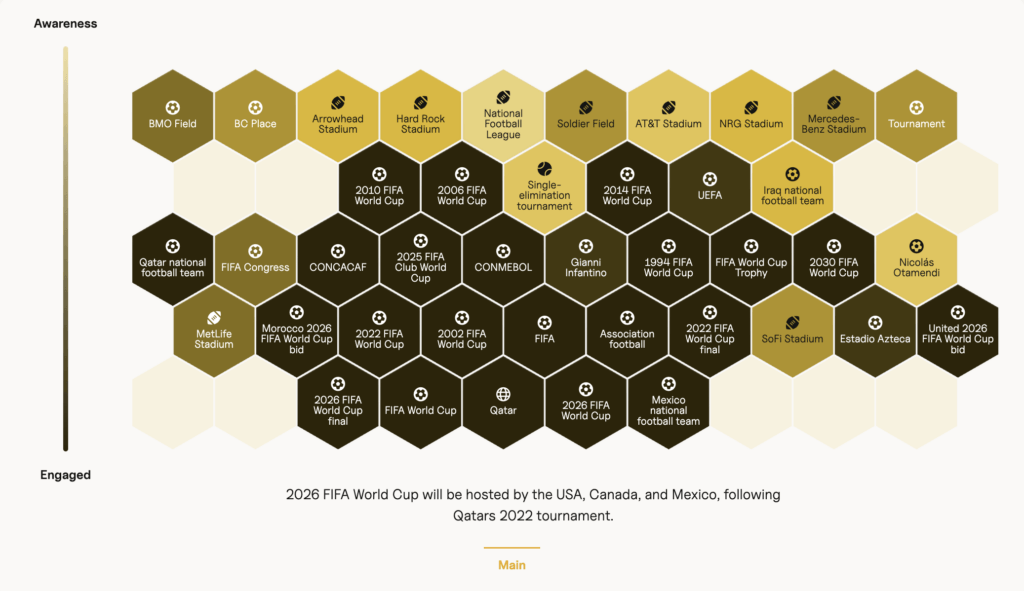
Top concepts for the World Cup 2026 audience model.
It also surfaced deeper concepts that revealed broader cultural connections, including:
- Shakira
- Cristiano Ronaldo
- Adidas
- TikTok
- MetLife Stadium
- Boston and other host venues across North America
That is the real value behind real-time audience intelligence.
The World Cup audience is more than a collection of soccer-related keywords. It is a living ecosystem of culture, geography, entertainment, identity, fandom, travel, and real-time attention that IntentKey AI can analyze to build dynamic audience models.
Note: The IntentPath visualization (above) within the IntentKey Platform shows only a snapshot of the concepts influencing an audience model. Users can download the JSON file from any audience model to explore the full list of concepts, audience trends, sentiment trends, geography, demographic indexing, and concept groupings. Create a free account at intentkey.com and save a model to your profile to unlock JSON downloads.
Why Concepts Go Beyond Traditional Audience Segments
A predefined audience segment uses keywords and relies on outdated data to reach audiences by bucketing users into the same pool of people that competitors are all going after.
Concept-level targeting with IntentKey AI goes further, taking into consideration the nuances, relationships, evolving behaviors, content consumption patterns, and trends that form real-time intent and align with the reality of the modern consumer.
That distinction matters during cultural moments because content consumption patterns are constantly moving.
For example, a consumer engaging with Shakira in the context of the World Cup may also be engaging with content from other opening ceremony performers or researching summer festivals where those musicians are performing. A consumer engaging with MetLife Stadium may be planning travel logistics or recently purchased tickets to a matchup. Another consumer engaging with Adidas may be shopping for official merchandise or simply shopping for new sports equipment.
They may all fit within the broader World Cup audience, but their motivations are not the same at any given moment.
IntentKey AI understands how those motivations and behaviors form and evolve and knows when to serve ads based on real-time intent more accurately than outdated segments.
That is especially important for a global event like the World Cup, where cultural nuance matters.
How Consumer Intent Moves Faster Than Audience Segments
Static audience segments assume people remain relatively fixed, but live cultural moments prove the opposite.
As matches begin, storylines change and sentiment shifts based on what is happening across the tournament.
The audience a brand activates on Monday may not be the same audience available by Thursday, or even later that same day.
That is why an audience intelligence solution that detects emerging intent in real time is critical.
IntentKey audience models refresh every five minutes, helping marketers keep pace with the latest signals shaping consumer intent in real time. Instead of relying on a fixed segment built around yesterday’s assumptions, brands can align media to the current version of an audience as it evolves.
Consumer engagement is not stagnant. It spikes, shifts, and fragments across devices and channels.
Marketers need an agile approach that is as dynamic as the consumers they are trying to reach.
How Geography Adds Another Layer of Intent
The 2026 World Cup IntentKey audience model also revealed geographic concentration across major U.S. markets, including states such as California, Texas, Florida, New York, New Jersey, Massachusetts, and others as shown below.
That pattern makes sense when viewed through the lens of soccer culture, population density, host city activity, and the presence of professional soccer leagues across the country.
But geography is more than a location signal. It can also uncover deeper narratives that help decipher the why behind an audience.
A World Cup audience in California may be shaped by different concepts than one in Texas, New Jersey, Florida, or Massachusetts. Some markets may over-index around host venues. Others may reflect national team affinity toward one country over another.
For example, take this IntentKey Platform audience model for the Mexican National Football Team. Looking at the map, we can see that the states with the highest engagement are states with dense Hispanic populations.
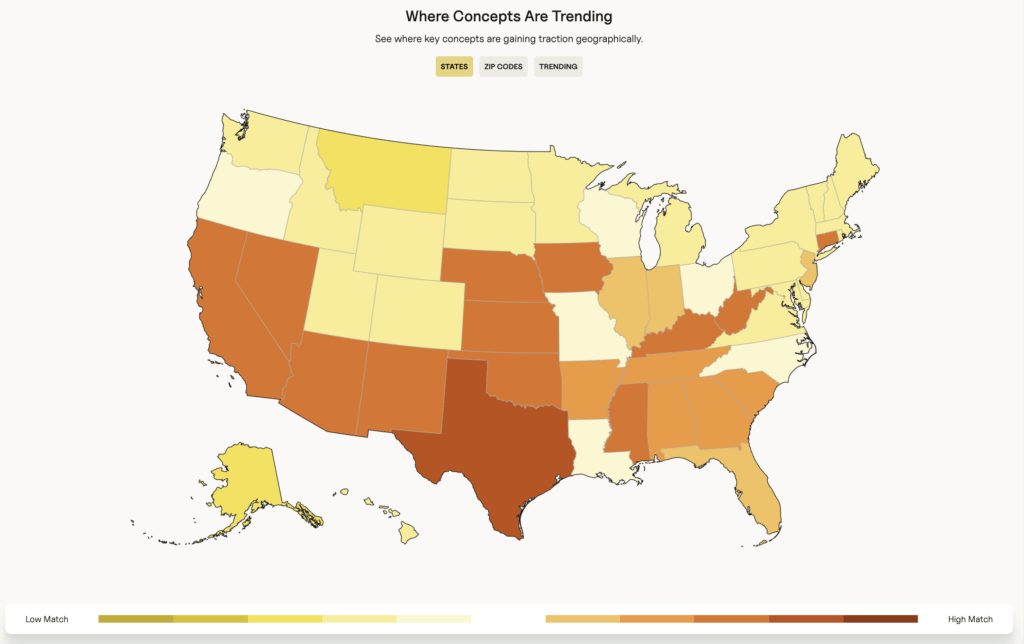
IntentKey surfaced the concepts with the highest engagement for a “Mexican National Football Team” audience model correlating with states that have a dense Hispanic population.
These geographic and demographic insights are AI-inferred patterns derived from real-time concept analysis, content consumption behaviors, and audience signals across the open web. They are not based on cookies, personal identifiers, or individual-level tracking.
For marketers, this creates an opportunity to think beyond national reach. Strategic marketers could use these insights to implement Spanish-language creative that resonates even more deeply with the audience.
A brand can activate a broad World Cup model, but it can also explore more specific variations based on geography, motivation, or campaign objective.
For example:
- A travel brand may want to understand consumers exploring host cities and road trips.
- A retail brand may want to focus on apparel, merchandise, and fan culture.
- A quick-service restaurant may want to reach consumers planning watch parties or game-day gatherings.
- An automotive brand may want to connect with families traveling for summer events.
The World Cup is the common thread, but the motivations inside that audience are very different.
The Opportunity Is Not Reaching the Same Audience Pool
One common question marketers may ask is whether activating a World Cup audience simply means competing for the same audience pool as everyone else.
With static segments, that concern is valid.
If every advertiser is targeting “soccer fans,” “sports fans,” or “World Cup viewers,” many brands are competing for the same broad group with little differentiation.
IntentKey audience models are built from concepts and refreshed continuously, meaning the audience model can evolve as consumer intent evolves. The audiences are not limited to a fixed categorization or identity of a consumer. It reflects what consumers are engaging with, what topics are gaining momentum, how sentiment is shifting, and which concepts are becoming more relevant in the moment.
That means marketers can activate the broad World Cup audience, or they can build more precise variations based on their own strategic angle.
What the World Cup Reveals About Modern Marketing
The World Cup reveals a simple but important truth:
Consumers do not fit neatly into audience segments.
They are shaped by culture, geography, experiences, interests, behaviors, and moments that overlap in real time.
That is why major cultural moments are so powerful. They create new opportunities to reach audiences while simultaneously exposing the complexity of the modern consumer.
For marketers, the challenge is no longer just finding an audience large enough to target.
The challenge is understanding what is motivating that audience right now and avoiding wasted media spend chasing the same audience pools as everyone else.
The brands that can identify those motivations, adapt as they evolve, and align media to real human intent will be better positioned to connect with consumers during cultural moments that move quickly.
Explore the Model
View the 2026 FIFA World Cup audience model or build a custom audience model of your own on the IntentKey Platform.
Frequently Asked Questions
What is real-time intent?
Real-time intent refers to the current signals that reveal what consumers are interested in, researching, discussing, or engaging with across digital environments. Unlike static audience segments, real-time intent changes as consumer behavior, cultural moments, trends, and sentiment shift.
Why are cultural moments important for marketers?
Cultural moments create concentrated attention, but that attention is rarely one-dimensional. Events like the World Cup, Super Bowl, Olympics, award shows, and major holidays bring together different motivations. Understanding those motivations helps marketers connect with audiences in more relevant ways.
How does IntentKey analyze live cultural moments?
IntentKey AI analyzes open-web content consumption patterns across contextual signals, behavioral patterns, sentiment, and trends to build audience models using concepts. This helps identify how audiences are forming and evolving around a cultural moment without relying on cookies or personal identifiers, and without using outdated audience segments.
Why are static audience segments limited during live events?
Static audience segments are often built around fixed assumptions and stagnant data, such as “sports fans.” During live events, consumer attention changes quickly as trends and cultural signals emerge. A static segment can’t adapt to those shifts.
How often do IntentKey audience models refresh?
IntentKey audience models refresh every five minutes, allowing marketers to work with a real-time view of consumer intent as signals evolve across the open web.
Can brands build more specific audiences from a broad cultural moment?
Yes. A broad World Cup audience can be refined into more specific audience models based on campaign goals, such as travel interest, host cities, family gatherings, apparel, food and beverage, entertainment, national team affinity, or other motivations connected to the event.
Why does concept analysis matter for audience targeting?
Concept analysis helps reveal the relationships between ideas, interests, behaviors, and cultural signals. Instead of targeting only keywords or broad categories, marketers can better understand the motivations that connect consumers to a topic, event, or brand.
Is the World Cup audience only valuable for sports brands?
No. While sports brands have an obvious connection, the World Cup creates opportunities for travel, retail, automotive, financial services, food and beverage, entertainment, telecom, and other categories. The key is identifying which motivations within the event align with the brand’s audience and campaign objective.