


Last weekend, social media, entertainment outlets, and news publications were flooded with coverage surrounding Taylor Swift and Travis Kelce’s wedding. While most people saw celebrity news, marketers were presented with something far more valuable: a real-time cultural moment capable of creating entirely new commercial opportunities.
As conversations spread across the open web, IntentKey detected rapidly expanding audiences not only around Taylor Swift and Travis Kelce, but also luxury brands including Cartier, Christian Louboutin, Dior, Madison Square Garden, and dozens of adjacent concepts. Each became its own audience opportunity, complete with unique sentiment, motivations, demographics, and concept relationships.
This is one of the most underutilized applications of IntentKey. Rather than simply identifying what is trending, it helps marketers understand why audiences are forming, how those audiences evolve, and where opportunities exist to inform creative strategy, messaging, media investment, or activate privacy-safe programmatic campaigns while engagement is still emerging.
How Marketers Can Leverage Cultural Moments in Real Time
Most marketers view cultural moments as singular events.
Taylor Swift trends.
The Super Bowl kicks off.
A blockbuster movie premieres.
A product launch goes viral.
Consumers don’t experience these moments through a single lens, and neither should marketers.
As attention surrounding the wedding accelerated, IntentKey detected multiple concept ecosystems forming simultaneously. Taylor Swift, Travis Kelce, luxury fashion, jewelry, sports, entertainment, and lifestyle audiences all experienced measurable shifts in attention, each evolving differently despite originating from the same event.
Taylor Swift’s audience alone grew from 7.3 million the day before the wedding to 29.1 million on the day of the event before peaking at 55.5 million the following day.
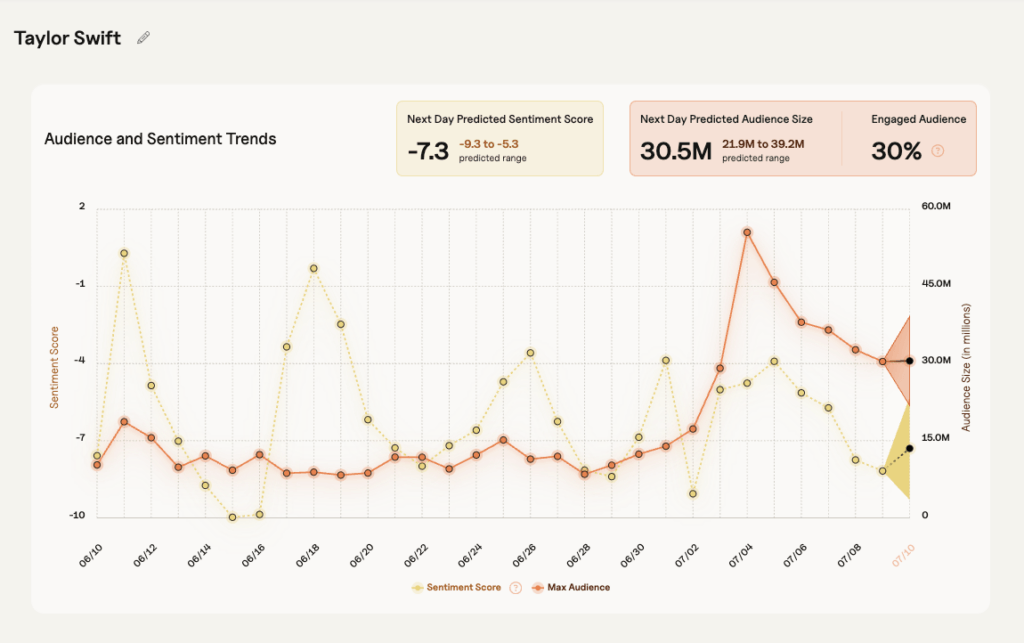
IntentKey detected a significant spike in Taylor Swift’s audience surrounding the wedding while sentiment remained consistently negative, demonstrating how audience growth alone doesn’t tell the full story. Real-time audience intelligence provides marketers with deeper context into how cultural moments evolve across the open web.
Rather than producing one massive audience, the event created multiple audience variations.
Taylor’s audience centered around entertainment, celebrity culture, and luxury brands. Travis Kelce’s remained rooted in football, sports media, and the NFL. The wedding temporarily connected those ecosystems, creating new audience opportunities at the intersection of sports, fashion, luxury, and entertainment.
This is where IntentKey differs from traditional social listening.
Social listening helps marketers understand what people are talking about.
IntentKey extends that understanding by transforming those conversations into transparent, real-time audience models that marketers can analyze, monitor, and activate. Instead of reacting to trends after they peak, marketers can observe audiences as they form, uncover adjacent opportunities, and activate campaigns while engagement is still growing.
What Real-Time Audience Growth and Sentiment Revealed
Audience growth was only part of the story.
IntentKey also surfaced a notable shift in sentiment across the audiences connected to the event.
Taylor Swift’s audience maintained consistently negative sentiment throughout much of the conversation, reflecting criticism, speculation, and online debate despite experiencing extraordinary audience growth.
Meanwhile, many of the luxury brands associated with the event maintained significantly more positive sentiment while experiencing meaningful audience expansion of their own.
Understanding both audience growth and sentiment provides marketers with a far more complete picture than volume alone.
A rapidly growing audience isn’t always enthusiastic.
Likewise, negative conversation doesn’t eliminate commercial opportunity.
These additional layers of context help marketers evaluate partnerships, creative direction, messaging, and media investment with a much clearer understanding of the environment surrounding a trend.
How One Cultural Event Created Multiple Audience Variations
One of the most interesting findings wasn’t how many people were talking about luxury brands.
It was why they were talking about them.
Most marketers would assume Cartier, Dior, and Christian Louboutin belonged to one broad luxury audience.
IntentKey revealed multiple audience variations emerging from the same cultural moment.
Cartier’s audience developed around concepts related to craftsmanship, precision engineering, watchmaking, chronometry, and horology.
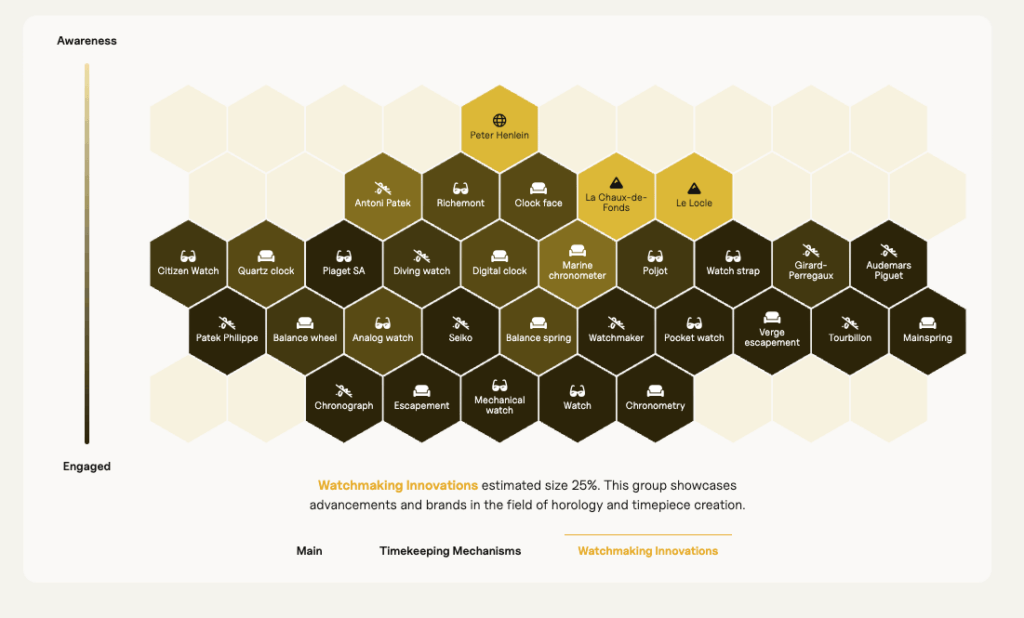
IntentKey’s Concept Ecosystem reveals that Cartier’s audience extends beyond luxury jewelry into watchmaking, horology, and craftsmanship. These concept relationships help marketers understand the motivations driving audience engagement and uncover new audience variations for more informed creative strategy and media planning.
Rather than engaging purely with luxury or status, a meaningful portion of the audience was engaging because of an appreciation for craftsmanship and technical expertise.
Christian Louboutin and Dior evolved differently.
Their audiences expanded around luxury fashion, couture, footwear, styling, tailoring, handbags, beauty, and fashion culture.
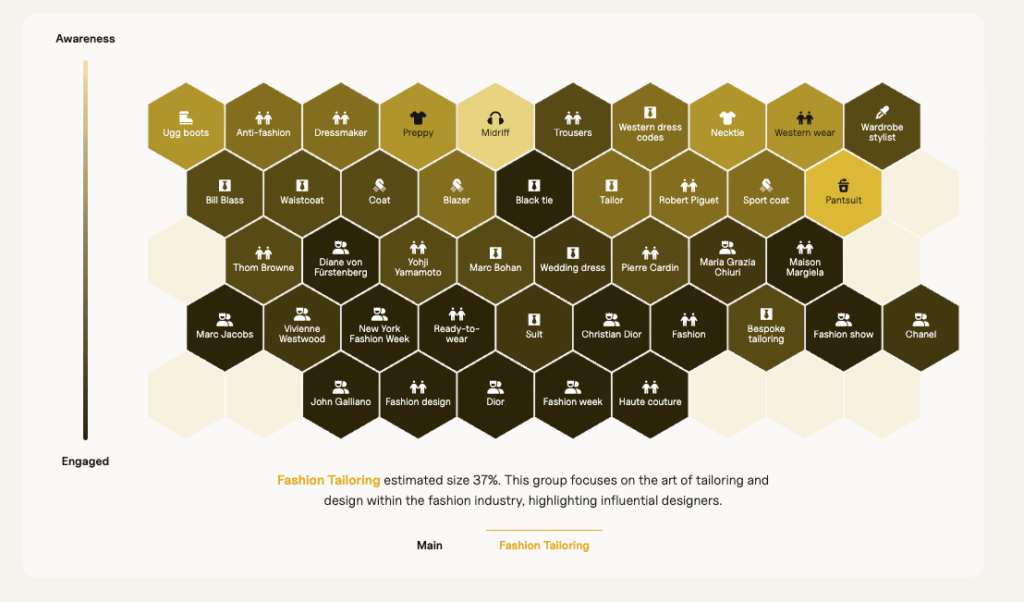
IntentKey’s Concept Ecosystem reveals that Dior’s audience extends beyond luxury fashion into tailoring, couture, and craftsmanship. These concept relationships uncover the motivations shaping consumer engagement, helping marketers build audience variations and inform creative strategy, messaging, and media investment.
Same cultural event.
Different motivations.
Different audience variations.
For marketers, these distinctions create opportunities to tailor messaging, creative, merchandising, and media investment around the motivations driving engagement instead of relying on broad audience assumptions.
How Marketers Can Apply Real-Time Audience Intelligence
Not every audience model needs to become a campaign.
Sometimes the greatest value comes from simply watching audiences evolve.
Marketers can build audience models around emerging cultural moments to monitor:
- Audience growth
- Sentiment shifts
- Concept evolution
- Geographic trends
- Demographic composition
- Emerging audience variations
Those insights can help marketers:
- Identify emerging audience opportunities before competitors.
- Inform creative strategy based on the concepts driving engagement.
- Refine campaign messaging around audience motivations rather than assumptions.
- Prioritize media investment where interest is growing geographically.
- Build audience variations around adjacent concepts as conversations evolve.
- Activate privacy-safe programmatic campaigns while engagement is still building.
For retail, luxury, lifestyle, entertainment, and consumer brands, these insights provide an opportunity to move beyond reactive marketing and align campaigns with consumer attention while it is still emerging.
Looking Beyond the Headlines
The next major cultural moment won’t announce itself as a marketing opportunity.
It will quietly create hundreds of new audience opportunities.
Most brands will only see the headline.
The brands that move first will understand why those audiences are forming and where new opportunities are emerging.
The marketers who recognize those signals first gain more than a trending topic. They gain earlier audience intelligence, stronger creative direction, smarter media investment, and the ability to engage consumers while attention is still emerging rather than after it peaks.
Want to see these insights firsthand? Explore the Taylor Swift audience model to experience how IntentKey surfaces concept ecosystems, audience variations, and real-time audience intelligence. Then build your own AI-powered audience models around the brands, trends, events, or cultural moments that matter most to your business.
Frequently Asked Questions
What is a concept ecosystem?
A concept ecosystem is the network of related topics, themes, brands, interests, events, and conversations that naturally form around a subject as consumer attention evolves across the open web. Rather than viewing a trend as a single topic, IntentKey analyzes how concepts connect and influence one another in real time, revealing the motivations shaping consumer interest before traditional audience segments emerge.
What is an audience ecosystem?
An audience ecosystem is the collection of distinct audience variations that emerge from a concept ecosystem. While a cultural moment may appear to create one audience, it often generates multiple overlapping groups driven by different motivations, interests, and behaviors. Understanding these audience ecosystems helps marketers tailor messaging, creative, media investment, and activation strategies with greater precision.
How is IntentKey different from social listening?
Traditional social listening measures what people are saying across social platforms. IntentKey analyzes concept relationships across the open web to understand why audiences are forming, how they evolve, and which new audience opportunities are emerging. Instead of simply reporting on conversations, IntentKey transforms those insights into transparent, privacy-safe audience models that marketers can analyze, monitor, and activate programmatically.
Why do cultural moments create new audience opportunities?
Major cultural moments, such as sporting events, award shows, product launches, breaking news, or celebrity events, rarely generate a single audience. As conversations spread, new concept ecosystems develop around brands, products, interests, locations, and experiences. These evolving concept relationships create new audience variations that marketers can leverage to inform creative strategy, messaging, media planning, and audience activation while engagement is still emerging.
How can marketers use concept ecosystems and audience ecosystems?
Marketers can use concept ecosystems to understand the relationships and motivations driving consumer attention, then use audience ecosystems to identify and engage the most relevant audiences. Together, they provide a more transparent approach to audience intelligence by helping marketers monitor audience growth, sentiment, demographic and geographic trends, uncover adjacent opportunities, create audience variations, and activate privacy-safe programmatic campaigns based on real-time consumer intent rather than static audience segments.