


The Holiday Travel Rush Has Passed. Travel Planning Has Not.
The holiday travel season has officially wound down. For travel advertisers, this moment highlights why early intent travel marketing matters. Campaigns have run, trips have happened, and many brands are already looking ahead to what comes next.
According to a Deloitte survey, nearly half of Americans traveled during the holiday season, making it one of the most competitive moments of the year for travel advertisers. But once the holiday rush fades, travel intent does not slow down. It simply shifts.
Right after the holidays, travelers begin planning future trips. According to Google, spring break travel searches spike sharply in January and the lowest prices for trips in March or April are in the 28-61 days prior to departure, while the lowest prices for international flights are 49 days before departure. This means that as holiday campaigns wrap up, a new wave of savvy warm weather planners are already doing their homework. Additionally, a majority of Canadian travelers plan trips one to six months in advance, placing their early research squarely in the winter months, according to Travelweek.
This post-holiday window is where opportunity opens up. Travelers are no longer reacting to the urgency of the season. They are exploring ideas, comparing experiences, and forming preferences for spring and summer travel.
Understanding how travel intent evolves after the holidays is essential for advertisers who want to influence travelers before destinations are chosen and demand becomes harder to capture.
Why Targeting Travelers Too Late Limits Growth
Many travel campaigns rely on signs of interest that appear late in the planning journey, such as destination-based keywords or keywords and criteria extracted from a destination website. These signals are useful, but they reflect travelers who already know what they want.
Travelers consider multiple destinations before narrowing their choices. If a brand only activates when someone searches for a specific destination, it is targeting travelers at the end of their journey, not the beginning.
In the path to purchase research process, early travel intent forms long before bookings occur. People start comparing experiences, browsing trip themes, researching outdoor getaways, exploring seasonal ideas, or evaluating logistics. These signals appear months before a traveler commits to a specific place.
By the time a destination-specific signal appears, the opportunity to influence discovery has already passed.
From Destination-Led to Early Intent Travel Marketing
Travel marketers often ask how to generate more inbound demand or scale their reach. The answer is rarely to push destination messages harder. It is to understand the motivations behind why people are thinking about travel at all.
Many travelers do not start their journey with a specific destination in mind. They begin with ideas like:
- Outdoor activities
- Music or cultural experiences
- Scenic escapes
- Family road trips
- Warm weather getaways
This discovery phase represents one of the largest untapped opportunities in travel advertising. It is where inspiration and influence have the strongest impact.
This is where demand-led marketing becomes essential. Instead of only targeting people who already have a location in mind, brands need the ability to identify and reach travelers whose motivations naturally align with what they offer, even if the traveler is not yet thinking about a specific place.
IntentKey AI as the Audience Intelligence Layer for Early Intent Travel Marketing
To reach travelers in this early discovery stage, marketers need visibility into why people are entering the market, not just what they search for.
IntentKey functions as an audience intelligence layer that fills this knowledge gap. It analyzes billions of pages and ad impressions to understand emerging intent signals across the open web. Models refresh every few minutes and identify high intent audiences a full 24 hours before competitors that are going after the same audience.
Instead of waiting for specific destination signals to appear, IntentKey detects when someone begins engaging with concepts like outdoor adventure, seasonal experiences, family activities, cultural events, music tourism, or international travel logistics. These signals are mapped into IntentKey’s IntentPath to understand relevancy and correlation between concepts. These concepts reveal interest before travelers narrow their choices.
This early window opens the door to scalable prospecting and discovery, which destination-led strategies often miss.
Filling the Knowledge Gap for a Southern State Destination
One example that illustrates this clearly involves a southern US destination known for iconic landscapes, outdoor recreation, scenic beauty, and music culture. The goal was to grow travel interest from Canada, but early campaigns faced a ceiling. Initial targeting focused on an audience already familiar with the destination, which limited scale.
IntentKey filled this knowledge gap by blending specific destination concepts unique to that location like iconic landmarks or activities, along with broader early stage intent signals. The custom pixel-free model surfaced audiences beginning to research themes that aligned with the destination’s experiences, including:
- International flight planning
- Outdoor travel and adventure
- Family music related trips
- Seasonal travel exploration
These intent-identified travelers were earlier in their planning journey and had not yet committed to a destination. They represented untapped demand.
The shift unlocked measurable results. Video Completion Rate increased more than 25 percent and brand awareness rose significantly within an eight week period. This demonstrated how intent based prospecting reaches audiences who would otherwise remain invisible in traditional travel targeting.
How Does Intent-Based Targeting Work Outside of Travel?
Travel is not the only category where intent reveals what traditional targeting cannot. A consumer electronics brand selling noise canceling headphones faced the same challenge. Standard audience segments were logical but limited in scale.
IntentKey uncovered an unexpected high indexing audience: pug owners.
Pug owners often experience disrupted sleep due to their dogs’ snoring and breathing issues caused by a short snout. This created an unarticulated but powerful need for noise reducing solutions.
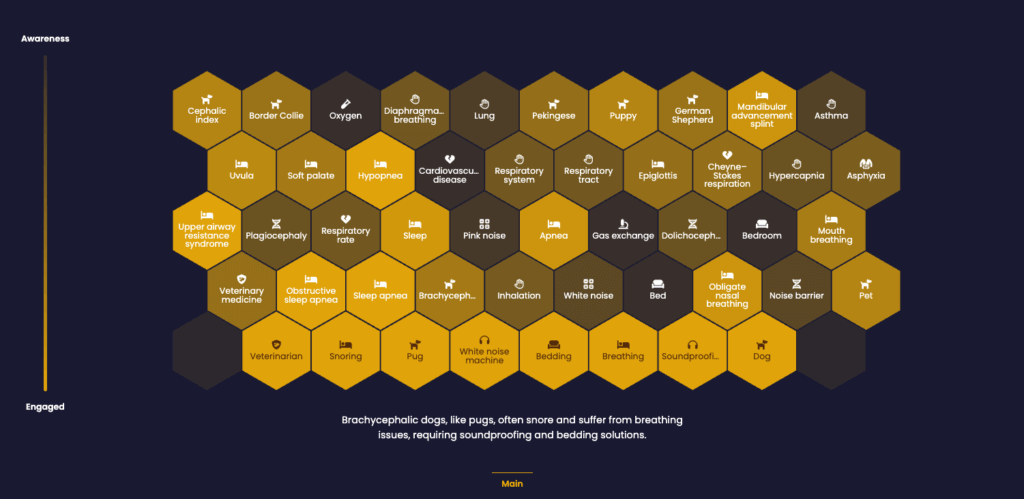
Example of how the IntentKey Platform’s IntentPath maps the audience journey from awareness to engagement and how concepts correlate, specifically for noise cancelling solutions and pug owners in this scenario.
This insight represented another knowledge gap. These consumers would never be able to be reached with outdated segment targeting because they weren’t discovered as a potential high-value audience, yet IntentKey’s ability to detect and measure intent revealed that they were.
The brand built tailored creative and activated campaigns against this intent based audience, leading to meaningful increases in engagement and performance.
This example illustrates how IntentKey’s audience intelligence uncovers insights that brands themselves might not even know could lead to new audience demand.
Turning Seasonal Shifts Into Year-Round Opportunity
Demand does not pause between travel seasons. It shifts.
Audience intelligence changes that dynamic. By identifying real-time intent early, brands can reach travelers while they are actively planning, discovering, and still open to inspiration. This demand-led approach turns post-holiday lulls into high-impact windows for prospecting, discovery, and demand creation.
Whether you are looking to understand emerging travel demand, uncover untapped audiences, or activate earlier in the journey, early intent travel marketing with IntentKey allows brands to identify travelers based on real-time intent signals, rather than waiting for destination-specific searches to appear.
Learn more about IntentKey and how it helps brands identify high-intent audiences earlier, or build your own AI-powered audience model on the IntentKey Platform. If you have questions, reach out to our team to explore how IntentKey can support your upcoming travel campaigns.
Frequently Asked Questions
Audience intelligence refers to the process of identifying why a traveler is entering the market, not only who they are or what destination they search for. It reveals early motivators and emerging signals that appear long before bookings occur.
Early stage intent allows brands to reach travelers before they narrow their destination choices. This approach supports brand awareness while reducing overreliance on lower-funnel campaigns, where competition and costs are higher. By engaging travelers earlier in the planning process, brands can shape consideration, build genuine interest, and influence decisions before preferences are set. This is why early intent travel marketing plays a critical role in driving awareness and influencing travel decisions earlier in the journey.
Intent-based models can identify untapped audiences whose motivations align with travel experiences, even if they have not yet expressed destination-specific interest. This expands reach beyond travelers already familiar with a place and allows brands to influence consideration earlier. By fueling the top of the funnel with qualified demand, intent-based prospecting supports stronger performance throughout the entire journey.
These signals vary by market and destination. Intent models can combine broad planning concepts with destination-specific signals, including concepts extracted from a brand’s site or the regions it aims to reach, to build more accurate and scalable travel audiences. This custom approach is part of our managed service.
Yes. The pug example demonstrates how intent can uncover hidden demand in retail, consumer electronics, and other verticals by revealing needs consumers do not explicitly state.